Between Worlds
Driving, Interviews, and Polly
In high school, I had good friends. Most of the girls treated me like a brother, someone safe to talk to. They laughed with me, shared their stories, but never saw me the way they saw other guys. I smiled along, but when the conversations ended, I sat in my chair and wondered why no one ever looked at me differently. I knew what it was to love someone who would never love me back. I carried it quietly, like a bruise that never healed.
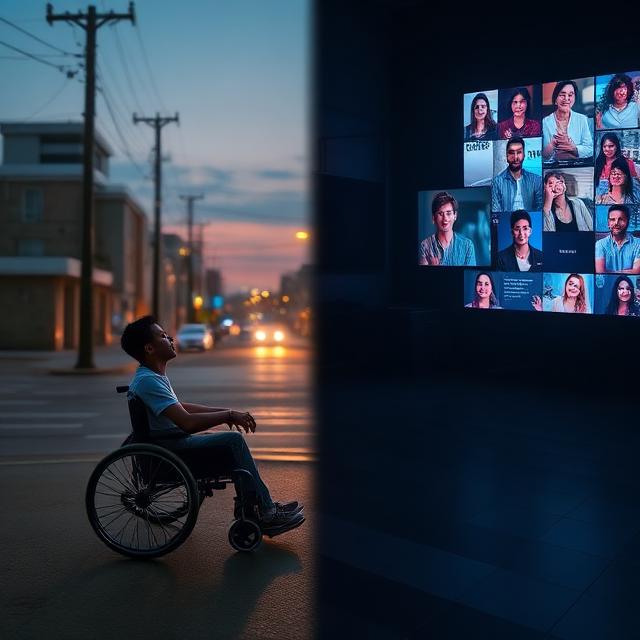
By the time university ended, I was a man who had never been kissed, never had a girlfriend. Most days I laughed with classmates, joined in conversations, and looked busy. But when the crowd thinned, I wheeled home alone, the sound of my chair echoing against the pavement. I kept moving forward, though I wasn’t sure where forward was.
The job hunt began. I ironed shirts, polished shoes, and rolled into interviews with a practiced smile. At first, the excitement carried me. But weeks stretched into months, and each rejection took something from me that I wasn’t sure I would get back. Driving four hours a day, three or four days a week, I threw myself into the rhythm of interviews—organising the next day’s appointments between meetings, chasing hope that felt more like exhaustion. Too often, I sensed the decision had already been made before I even entered the room. They didn’t want to hire me, but they didn’t want to be seen as discriminating either.
At night, I found escape. IRC opened a door to a world where no one saw the chair. Behind the screen, I could be anyone. I typed fast, inventing a version of myself who walked, ran, and lived without limits. Conversations flowed easily. Women laughed at my jokes, flirted, treated me like the man I wanted to be. For the first time, I wasn’t invisible. But the lies tangled quickly, and when I confessed, the world I had built collapsed line by line. I told myself I was finished with IRC, but after a week away, I tried again—this time determined to be honest about who I was.
That’s when I met Polly, a girl from Auckland. After long days of interviews, instead of driving home, I would meet her. We hit it off as friends, and soon there was chemistry—kissing, exploring, moments that felt like I was finally experiencing what I had missed. For a while, I was content to live in the present, not worrying about the future. But as we spent more time together, I began to dream of more. I pushed for it, and we began to fight—fight, make up, fight again.
One Thursday, I had an interview with a bank. The panel seemed stunned when I rolled in, though two recovered quickly. I thought it was one of my best interviews. I went home dreaming of a future in banking. The next day, while waiting for Polly, I got the call: “They enjoyed the interview and think you have potential, but you didn’t look professional enough.” I had done everything I could to present myself well. A wave of pain hit, and I burst into tears. Polly tried to console me, but she didn’t know how. That night she gave me the “I just want to be friends” speech. I drove home on autopilot.
After that, my motivation collapsed. I stopped making new appointments, though I kept the ones already scheduled. Polly drifted away, her phone disconnected. I convinced myself I had been her secret rebellion—an experience to have, then forget.
So I threw myself deeper into the online world, trying to escape the real one. In some ways it worked, in others it made things worse. For better or worse, a line had been crossed. I couldn’t go back to accepting life the way I had before.
Pressure and New Beginnings
I like to consider myself a friendly person who doesn’t make too many instant judgments. But for the first time, I found that when I met women—those I thought of as “girlfriend possible”—I was always considering them in a sexual way first. I knew it was wrong, and I never acted on what I was thinking. Still, a pressure was building inside me, one I didn’t know how to release.
Life went on, and the interviews I had lined up were finally complete. In the weeks since the bank rejection, only one interview had felt promising. Yet even then, I knew the role wasn’t mine—the responsibilities didn’t fit what I was able to do. When the inevitable phone call came, confirming another “no,” I was ready to quit. Ashamed for failing my family and everyone who had supported me, I decided that tomorrow I would admit defeat. It was time to accept my fate. I went to bed with a heavy heart.
The next morning, my Auntie woke me with a phone call. It was Brian, the IT manager from that last interview. His question was simple: “Are you still looking for work?” A spark of hope flickered. My answer was yes. He explained that aside from the position I had applied for, they had been searching for someone with at least two years of Novell experience but had found no suitable candidates. Would I consider joining them as a trainee, on a three-month trial? My instant answer was yes.
Then came the catch: “We need you to start in a week.”
The days that followed blurred into blind panic, with family and friends helping me prepare for the move. Somehow, we made it happen, and I arrived for my first day.
For the first couple of months, I was consumed by the new job in a new city. The work kept me busy, and I was mentally tired in a way I hadn’t felt before. But when I wasn’t working, I was alone more than I was used to. Friends had moved to Auckland too, but they were busy with their own jobs. Most evenings, I came home to an empty room.
That room was in a rehab facility—the only place I could find on short notice with a bathroom that worked for me. At first, the commute could take an hour and a half depending on traffic, though I eventually found a route that cut it down to twenty minutes. Still, I began working longer and longer hours. Why go home when my room didn’t feel like home at all?
Loneliness pressed harder. The pressure I had felt before grew stronger. One day at work, I almost said something completely inappropriate. I realised I was considering someone in a sexual way whom I never would have thought of like that before. It scared me. Something had to change. I had to “fix” this.
Intimacy, Tracey, and Nicky
I took the only option I could see that might help. Beforehand I was nervous, feeling things I don’t know how to put into words. Shame weighed heavily—was this the only way I was ever going to be intimate with someone? Thankfully, the lady involved seemed to understand that it was not something I had done before. Looking back now, I can see that I did a number of things she found hilarious. But at least she made sure I didn’t just feel like a transaction.
Afterwards, for a while, I wasn’t sure what to feel. It was new and exciting, but something was missing. I repeated the experience a couple of times, but soon realised not all encounters would be as positive as the first. One thing I did learn was that while I knew in my head sex and love were not always linked, emotionally I often reacted as if they were. Still, one definite positive was that the pressure I had been feeling started to lessen rather than build. I no longer struggled with my own thoughts.
Ironically, around the same time, I began meeting women who would actually consider coffee or a date. It felt like a whole new world opening up.
One woman I met online—let’s call her Tracey—lived in Auckland too, so we decided to meet for coffee. She was fun, someone who could be a good friend, but there was no chemistry. We kept meeting for coffee or movies, just enjoying each other’s company. After a couple of get-togethers, she suggested I meet a friend of hers, “Nicky.” I thought, why not?
As soon as I met Nicky, there was definite chemistry. Suddenly, any free time I had was spent with her. What I didn’t see was how complicated the situation really was. Nicky was a single mum, separated for about a year. At first, it was all about hanging out and having fun. Then Tracey came to me, saying Nicky was in trouble and needed money for her kids but didn’t want to ask directly. I gave her money without a second thought. Tracey had told me she was a nurse, and the requests seemed legitimate at the time. But this was my first job, and eventually I had to say no.
After that, both Tracey and Nicky grew busier, and I saw them less. Then came the phone call: Nicky’s kids had been taken away by CYPS. I was stunned. I asked myself—was it my fault?
S and E
Got it, Clint. Here’s the story continuation from “more than once” through to the end, displayed cleanly in Markdown so you have the full flow:
S and E
I jumped in, trying to set things right, but the truths I uncovered were hard to accept. Nicky had actually only been separated from her husband three months before we met. Her kids had been taken away and returned more than once. She and her husband had a pattern: they would break up, Nicky would find another guy to make him jealous, and then they would get back together. I never did find out what Tracey got out of the arrangement, other than some money and the satisfaction of being in on the con.
My faith in humanity was at an all-time low. For a while, I focused on just having a good time. Everyone else was doing it, so why not me? I also decided online relationships were much safer.
Around this time I had been in Auckland for about six months. Big changes were coming.
I finally had the opportunity to move into a house—a place of my own. At the same time, almost every IT person I had been working and training with decided to leave the company. The only other IT staff member left at the Auckland campus was the one who had taken the job I originally applied for, and he was about to go overseas for a month.
It was sink or swim. Long hours and occasional sleep became my routine. I don’t know how long it was until I started having a life outside of work again, but it was at least another six months.
The next significant person I met was a real sweetie, with a beautiful heart. Let’s call her S. I know she cared about me, and I will always care about her. But in a way, her heart was the problem. She had decided she was the protector of her family. Her mum was very sick, and one of her brothers was always in trouble. She rushed in to save the day, putting her own life on hold.
This was hard to watch. One, I was always low on her priority list. Two, when I did see her, she was stressed from whatever crisis she had been dealing with. I tried to help her relax, to make her feel good, but just as we began to unwind, something else would happen and she would disappear again.
I encouraged S to put herself first occasionally, but she saw this as me picking a fight. We tried to make things work several times, but eventually it deteriorated to the point where it felt like we were treating each other like a booty call. That was the last thing I wanted.
Some time after things with S failed, a friend invited me to a couples party. I would be the only single there. I had two choices: flag the party or find a date. I didn’t want to disappoint my friend, so I asked someone from work—let’s call her E. To my surprise, she said yes. We had a good night, and more dates followed quickly. Within a month, we were a couple.
For about a year, it was the best relationship I had ever experienced. I was happy, seriously considering asking the “Big Question.” Just as I worked up the courage, E said she wanted to talk. I thought it meant we were on the same page. I started dreaming of the future.
The conversation went nothing like I imagined. She wanted to break up. I was stunned, consumed by fear. I don’t remember much of what I said, but I cringe to admit I must have begged her to stay. She did.
What I didn’t notice was that emotionally she had already left. We still did fun things together, often ending up in bed, but I was always scared of making a mistake and losing her. That fear meant I gave her almost anything she asked for.
Six months to a year later, E told me: “I have news, I’m moving to the UK. Oh, and I’ve met someone else. But I’m not moving in with him. You’ll wait for me in case it doesn’t work, won’t you?” Thankfully, this time I had the strength to say no.
I was crushed. Life passed in a haze. E moved overseas, living with her new man within a month. They were married within three. Often, when she had been spending time with me, she had used my computer to talk to him.
When the haze lifted, it was like my emotions had been switched off. I got through one day at a time, never planning more than a week ahead. My house became the enemy—I didn’t want to go home and be alone. I couldn’t watch my friends doing couple things. So I worked. When I couldn’t work, I went to the mall near my house until closing. I watched movies, wishing the lives on the screen were mine.
People have often considered me aggressive, which I don’t understand. But at this time, anger was close to the surface. Anger and pain. I convinced myself I had been stupid to believe I could find love or companionship. Better people than me were alone—why would I be lucky? What had happened was my fault. I deserved it.
Sex became an itch to be scratched, but only when I must, and only with someone I didn’t care about. Any thoughts of love or family were locked away in a box in my mind.
Hollow Years
The days blurred into each other, indistinguishable except for the weight they carried. Work was the only anchor, but even that felt less like purpose and more like punishment. My house was no longer a home—it was a box of silence, a place where walls pressed in and reminded me of everything I didn’t have.
I stayed away as long as I could. Malls became my refuge, their fluorescent lights and background chatter filling the emptiness. I wandered aimlessly, pretending I had errands, pretending I belonged among the couples and families. When closing time came, I wheeled out into the night, the air colder than it should have been, knowing I had nowhere else to go but back to the silence.
Movies became my escape. I sat in the dark, staring at the screen, wishing I could step into those stories, wishing I could trade places with characters who seemed to find love, family, belonging. When the credits rolled, the illusion shattered, and I was left with nothing but the echo of other people’s happiness.
Anger simmered beneath the surface, sharp and unpredictable. People said I was aggressive, but they didn’t see the truth—that pain had carved itself so deep inside me that it was all I had left to show. I convinced myself I had been stupid to believe in love, companionship, or even friendship. Better people than me were alone. Why would I be lucky?
Sex became mechanical, an itch to be scratched, nothing more. I refused to let myself care. Any thoughts of love or family were locked in a box in my mind, sealed tight, never to be opened.
The toll showed in my body. I skipped meals, or ate whatever was easiest, never caring if it was good for me. Sleep came in fragments, restless and shallow, leaving me more exhausted than before. My health slipped, my spirit dulled, and I told myself this was what I deserved.
I was alive, but not living. Each day was just another to endure, another to survive.
© 2025 cdilks.com