A Body At War
Introduction
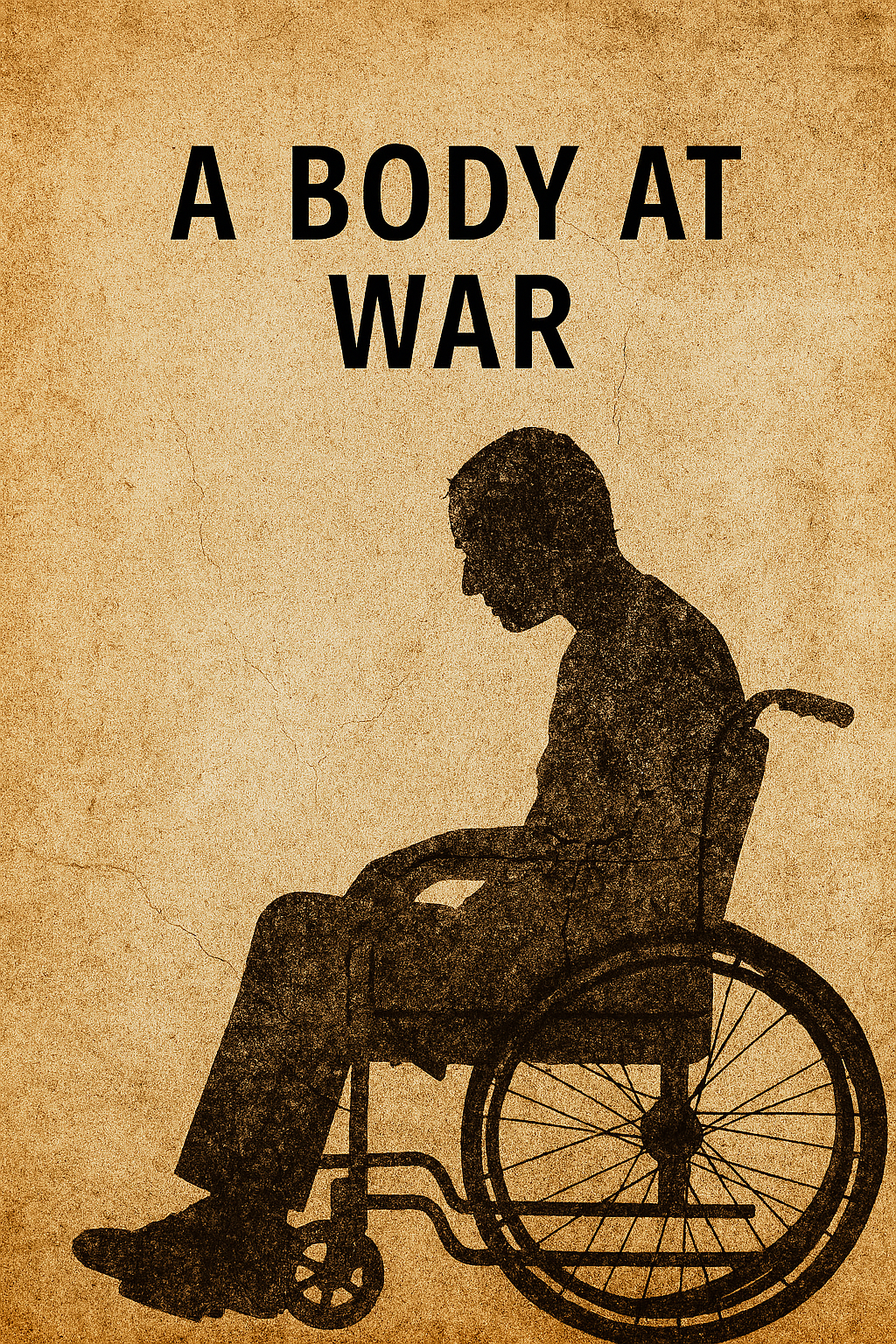
In A Body at War, the author invites readers into the unvarnished reality of living with pain, resilience, and the daily battles of life in a wheelchair. This is not a story of pity or triumph neatly tied with a bow—it is a raw exploration of what it means to fight your own body, to wrestle with shame and silence, and to search for meaning in brokenness. With honesty that cuts through pretense, the author reflects on the physical struggles that shape his days, the mental battles that haunt his nights, and the quiet questions about time and identity that linger in between.
This is a story about endurance, but also about vulnerability. It is about showing up to the fight, even when victory feels impossible. And it is about the courage to ask: when the body is broken, can the spirit still grow stronger?
Pain
Most people don’t think about pain all that much. For me, it’s a daily companion. Living in a wheelchair means there is always something that hurts—aching muscles, scrapes, joints that resist movement yet protest when they stay still too long. As a child, I remember days without pain. Somewhere in my late teens, normal shifted.
On good days, I acknowledge the pain but push it aside, tucking it into a corner of my mind. Being busy helps. On bad days, it’s a battle of will—doing what must be done while trying not to let anyone see. Because when people see, the pain feels heavier. My pain hurting me is one thing. My pain hurting those I care about is something else entirely.
Doctors and drugs terrify me. Not because I doubt they could dull the pain, but because I fear liking it too much—floating through life dependent on them, existing but not truly living. Some days already feel like that.
When my body refuses, I have two choices: listen and stop, or push through. Often if I keep pushing, I know I’ll pay for it later. Sometimes I’m forced to stop halfway through something important, suspended in no man’s land while my body decides whether to give me one last ounce of strength or drop me to the floor. There’s a special kind of madness in wishing your body understood that finishing one last transfer would be easier than collapsing and clawing your way back up.
Fighting Myself
Do you ever feel like you’re fighting yourself? I feel it constantly. Usually it’s physical—like I’m one arm and not much else. Even as I type, part of me wants to give in and type as though I only have one hand, forgetting about the limb I call claw.
I tell myself I don’t have to win the war. I just have to not lose today. Some days that quiet voice asks if I’m kidding myself. On the worst days it’s a roar. But good day or bad, I’m proud that I show up to the fight.
Mental battles are harder. Splitting your mind into pieces, fighting on too many fronts. And no one fights dirtier than the part of you that knows all your secrets—even the ones you can’t admit to yourself.
I’ve spent years hoping I’m strong in mind, to balance the weakness in body. But the truth is I’m probably weaker in mind than I want to accept. Even if I am “strong,” there will always be something stronger. So I try to be strong enough for today, regretting the days I fail.
Being strong for someone else is different. When it’s someone you love, the instinct is to rush in and fix things. But you can’t take their problem and solve it your way. You have to wait until they see the solution themselves. Even when asked for help, you must be sure you’re actually helping—not just taking over.
The Struggle Outside My Front Door
It was a dreary, wet day. I left work late, but not late enough to matter. Janelle was working, so the night was mine.
My chair went into the car easily. The drive home was uneventful. I put the chair back together without thought, but when I reached for my cushion I realized I had slipped down the side of the driver’s seat, just out of reach.
I thought about transferring without the cushion, but that would cause problems. So I lifted myself back, grabbed the cushion, and threw it onto the chair. Ready to transfer.
That cushion has been the bane of my existence lately—always shifting or bunching up. The trick is to lift high enough so it doesn’t move. That’s what I focused on.
Normally a transfer feels like moving up, then out. This one felt like up, then straight down. Pain shot through my knees. I slid down the seat, trapped in a position where I wouldn’t fall but couldn’t rise. I hung there for minutes, straining for that last centimeter of height. Finally, I got back into the seat.
I tried again. Fell straight down. Exhausted, my phone rang. I couldn’t answer. I tried again and again, losing count. Thirty, forty minutes passed, my car engine running the whole time. My thoughts were a stream of curses.
At last, one transfer worked. Not pretty, but enough. I was in my chair. The push up the ramp felt like climbing a mountain, but finally I was home.
Shame and Silence
For reasons I don’t understand, my body hates going backwards. Every action feels unnatural, broken into smaller parts. Maybe my brain is wired to keep moving forward.
As I struggled in the car, people walked past. They saw me. Not one stopped.
Part of me felt relief—I didn’t have to explain that there was nothing they could do. Another part felt sad that no one reached out. The biggest part felt shame. Shame that they saw, shame that I was in that situation at all.
Often when I struggle, I know I look ridiculous. In my mind I’m a stranded whale flopping on land. In rare moments of positivity, I imagine someone seeing my struggle without pity, maybe even with respect. But more often I know they’re thinking, thank God that isn’t me.
I love driving and the freedom it gives me. But when I struggle like this, I feel like a one-armed bandit. Almost everything seems too hard. Just once, even for a little while, I would love to be one of those physically able people. From the outside, it looks so easy.
Time and Brokenness
Lately I find myself thinking about time. Feeling old, nostalgic, wondering about the choices I’ve made. For so long I was driven—driven to succeed, to complete the next goal, to move on to the next step. Then all the goals seemed complete, and it was enough just to glide for a while. Live. Breathe.
But now I wonder what the next goal is. Is there really more to achieve, or is this as good as it gets? Not that now is bad—far from it. Life is good. But is it healthy to always want more, even when I don’t need it? Or should I embrace what I have, accepting that this may be as good as it gets, knowing that no matter how hard I try, time always wins?
For a long time, work was a goal in itself, something that defined me. Now it is not. It is simply a way to allow me to live.
While I live, I love—and that is the greatest blessing in my life. But along with great love I have met many broken people. Some are broken in ways that life’s trials can heal, shaping them into something stronger. Others are broken on a more fundamental level.
I wonder: am I too broken? The answer is most definitely yes. But the bigger question is—will I become something stronger, better? Or will I simply stay… broken.
```
© 2025 cdilks.com